Showing posts with label Geometry. Show all posts

Friday, 24 February 2017

Spherical Geometry


In this sphere, the line D is the diameter. A diameter is a straight line drawn from the surface and after passing through the centre ending at the surface.
Every section made by a plane passed through a sphere is a circle. If the plane passes through the centre of a sphere, the plane section is a great circle; otherwise, the section is a small circle.


Frustum of a Sphere

The portion of the surface of a sphere included between two parallel planes, which intersect the sphere, is called a frustum. The distance between the two planes is called height or thickness of the frustum.

The volume of a frustum of a sphere can be found using the formula below:


The surface area of a frustum of a sphere can be found using the formula below:

Wednesday, 22 February 2017

The Volume of a Prism

The volume of a prism can be found by first finding the area of the cross-section, then multiplying the cross-section by the length of a prism.


In this prism, the red areas are the cross sections.

Take for example this question.


The cross section is the square with sides 20 cm. The area of this square is 20 cm x 20 cm = 400 cm2. The volume of the cuboid is thus 400 x 40 = 16000 cm3.

Take a more challenging question.


The cross section here is the triangle. The area of the triangle is 0.5 x 8 cm x 15 cm = 60 cm2. The volume of the prism is 60 x 10 = 600 cm3.

Try this question.

Monday, 13 February 2017

Sectors of circles

The formula to find the arc length of a sector is shown in Figure 1.
Figure 1


The formula to find the area of a sector is shown in Figure 2.
Figure 2


Take for example Figure 3.
Figure 3


The area of this sector can be found out like below.


The arc length of the sector can be found out like below:

Wednesday, 8 February 2017

Radian Measure

In some calculations in circle geometry, radians are preferred to degrees.

An angle of 1 radian is the angle subtended by an arc with the same length as the radius shown below.


Conversions between radians and degrees


Arc Length

The formula to find the arc length is illustrated below:


Here, r is the radius and θ is the angle in radians.


If you had to find the arc length of a sector with a radius of 5cm and an angle of 80°, you would answer the question using this method - shown below.


Area of a Sector

The area of a sector can be found using this formula.


If we had to find the area of the sector in the previous example, we would use a method like this.


Tuesday, 7 February 2017

The Sine Rule, the Cosine Rule and the Area of a Triangle

To understand the sine and cosine rules, we need to view a triangle like this:


In these triangles, the small case letters are the sides and the capital equivalents to those letters represent the angles directly opposite them.


The Sine Rule

If, in a question, you are asked to find an angle in a triangle, and you are given two sides and another angle, you need to use the sine rule for angles.


Let's imagine that you are given a question like this and you have to find the angle:
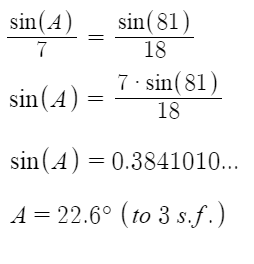
Use the first diagram and label the sides and their corresponding angles. Here the missing angle would be A and 7cm would be a, as that is the side opposite the missing angle. 81° would be B, meaning that 18cm would be b.

Putting these values in the formula shows us that:


If you are asked to find a missing side in a triangle with two angles and one side, you have to use the sine rule for sides, as illustrated below.


The method used here is similar to the method illustrated above.

The Cosine Rule

If you are given a question where you have to find the missing side given three sides, you would have to use the cosine rule for angles.


Let's imagine you are given a question like this where you had to find the angle:


If the missing angle is A, then 9cm would be a. 10cm would then be b and 11cm would then be c.

Putting these values in the formula shows us that:


If you are asked to find a missing side with two sides and an angle, you would have to use the cosine rule of sides.


The Area of a Triangle

If you have an angle and two sides in a triangle and you are asked to find the area, you have to use this formula:


Let us consider the second example on this page. A is 50.5°, b is 10cm and c is 11cm.


Putting these values in the formula gives us: